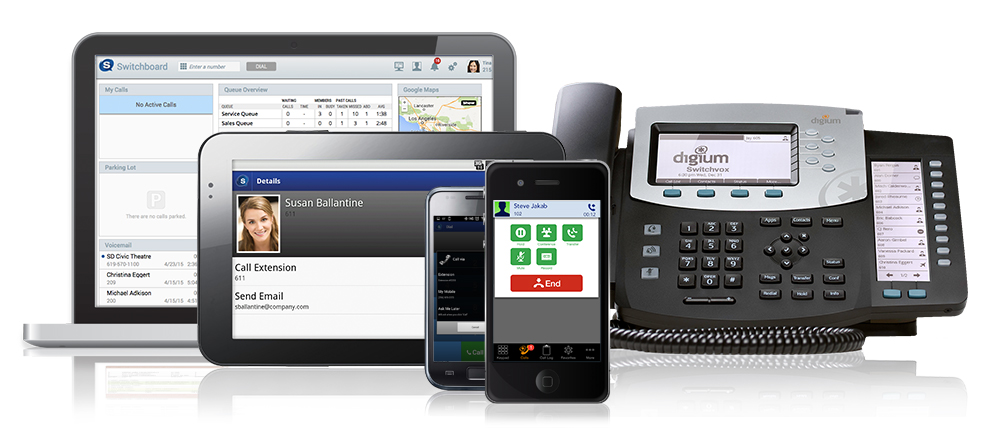
Switchvox is a Sangoma product — not sold or supported by Phonewire
Switchvox (originally a Digium product, now owned by Sangoma) is still commercially available and still receiving software releases. But the product has changed hands twice, older versions have reached end-of-life, and many long-time Switchvox businesses are re-evaluating whether to stay on the platform. If you’re running Switchvox and looking for support, migration guidance, or a fresh start with a fully managed system, Phonewire can help you evaluate your options honestly — including the option of staying put.
Moving Away from Switchvox? Here’s What Phonewire Recommends.
Phonewire has been installing and supporting business phone systems since 1998, and we know Switchvox better than most: we’ve deployed it for our own clients over the years, and two of our published case studies are Switchvox projects. That history is exactly why we can give you a straight answer about where the platform stands today — and what the practical alternatives look like.
What Usually Brings People to This Page
Almost nobody replaces a working Switchvox system on a whim. Three things bring people here: the Sangoma subscription or support renewal arrived; the appliance failed; or the installer who set it up no longer supports a product that has changed hands twice. If one of those is you, the answer is the same: keep the phones and wiring that still work, replace what is failing, and do it on a planned date instead of an emergency one.
How many phones are on your Switchvox system? Tell us the count and the building, and we come back with an itemized quote, not a range. Request a quote or call (800) 857-1517 — a real person answers.
What Happened to Switchvox? Digium, Sangoma, and Ten Years of Change
Switchvox built its reputation as Digium’s commercial phone system — the polished, business-ready product from the company behind the open-source Asterisk project. For years it was one of the best values in business telephony: powerful call queues, the drag-and-drop Switchboard, Salesforce integration, and serious IVR capability at a mid-market price.
Then the ownership changes started.
| Date | What Happened |
|---|---|
| September 2018 | Sangoma Technologies completes its acquisition of Digium, taking over Switchvox, Asterisk, and the Digium phone lines. |
| April 2021 | Sangoma completes its acquisition of Star2Star (announced January 29, 2021), adding a second, competing UCaaS platform to its portfolio. Switchvox is no longer the flagship cloud offering. |
| January 31, 2022 | Switchvox 5.X reaches official end-of-life. Systems on 5.x no longer receive updates or support. |
| March 20, 2026 | Sangoma releases Switchvox 8.4 — the platform is still being developed, but staying supported requires a multi-step upgrade path (8.x requires updating through version 7.9.5.2 first) and active subscription renewals. |
| June 30, 2026 | Switchvox 6.X reaches official end-of-life. Any business still on version 6.x is now running unsupported software — no security patches, no bug fixes. |
To be fair to Sangoma: Switchvox is not abandoned. Version 8.4 shipped in March 2026, and current subscribers on current versions are supported. But that’s exactly the catch — current versions, current subscriptions. If your business is still on Switchvox 5.x or 6.x, you are past end-of-life today. Getting back to supported status means an upgrade project, subscription renewals, and in many cases new hardware — which is why so many businesses treat this as the natural decision point to evaluate the market instead.
Why Businesses Move Away from Switchvox
What Switchvox Users Valued — And What Phonewire Delivers
The Switchboard and real-time call control
The Linkus UC client on desktop and mobile gives you presence, drag-and-drop transfers, and visual call handling — the modern equivalent of the Switchboard experience, extended to your smartphone and laptop.
Serious call queues and IVR
Call queues, ring groups, multi-level auto-attendant, and time-based routing are all standard on both Phonewire systems — not add-on licenses. Our team builds your call flows for you during installation and changes them at no charge afterward.
CRM integration (Salesforce and beyond)
Software integrations including Salesforce, HubSpot, Clio, and Microsoft 365 connect your phones to the tools you already use.
Call recording for compliance and training
Included, with straightforward retention controls — no per-seat recording license math.
One system, on-premises, that you own
The Phonewire Hybrid is a modern on-premises appliance at your location with a flat annual license — the same ownership model that made a Switchvox appliance appealing, without the version-EOL treadmill being your problem to manage. And unlike cloud-only options, it keeps working during internet outages.
Switchvox Cloud simplicity
If what you actually loved was Switchvox Cloud — no hardware, web-based management, per-user pricing — our cloud-hosted PBX is the direct modern equivalent, with the same U.S.-based support behind it.
What Phonewire Recommends for Switchvox Migrations
Phonewire Hybrid System
For businesses that chose a Switchvox appliance because they wanted to own their system, keep it on-site, and pay a predictable flat license — this is the direct modern successor.
- You own the system — a modern on-premises appliance at your location, not a rental
- Flat annual license — all features included, no per-feature or per-seat escalation as you grow
- SIP trunks sized to your actual call volume, not a fixed bundle
- Snom, Yealink, Poly, or Panasonic desk phones
- Optional cellular data network failover if your internet fails
- Full on-site installation plus same-day staff training
- U.S.-based support answered in under 1 minute
- Day-to-day changes at no additional charge
Phonewire Cloud-Hosted
For multi-location businesses, remote teams, or anyone who was already on Switchvox Cloud and wants the same model with a committed, single-vendor relationship.
- Predictable per-user monthly pricing — no hardware purchase
- Same Linkus UC mobile and desktop apps
- Voicemail to email, call recording, auto-attendant included
- Voicemail transcription available
- Microsoft 365 integration
- Consistent experience across all locations
- Same U.S.-based support and free change service
Not sure which fits? That’s what the free assessment is for. We’ll tell you which model matches how your business actually uses its phones — and if staying on Switchvox is genuinely your best move for now, we’ll tell you that too.
We’ve Seen Both Sides: Our Switchvox Case Studies
We’re not guessing about what Switchvox does well — we’ve published real customer stories about it.
A St. Louis healthcare technology company compared building on Asterisk vs. Switchvox Cloud
FormFast, a healthcare tech firm with 100+ remote employees and a call center, evaluated building its own Asterisk system against deploying Switchvox Cloud, and chose Switchvox Cloud for its call center features and native Salesforce integration.
A St. Louis language services provider moved to Switchvox Cloud
LAMP, an interpretation and translation organization, replaced a legacy system with Switchvox Cloud to automate interpreter dispatch with language-based routing and per-client phone numbers.
Those projects are why our take on Switchvox is credible: it was a genuinely good platform, and businesses that chose it made a sensible decision at the time. What’s changed is everything around it — the ownership, the version lifecycle, and the support ecosystem. The same needs those customers had are exactly what our current systems are built to serve.
What Migration Actually Involves
This is the same process we use for every legacy platform we replace — see all the systems we migrate, including Mitel and NEC.
Switchvox Migration FAQ
Is Switchvox discontinued?
No — and we won’t tell you otherwise. Switchvox is still sold and still receiving releases; Sangoma shipped version 8.4 in March 2026. What is discontinued are the older versions many businesses actually run: Switchvox 5.x reached end-of-life in January 2022, and Switchvox 6.x reached end-of-life on June 30, 2026. If you’re on either, your system no longer receives updates, security patches, or support.
Who owns and supports Switchvox now?
Sangoma Technologies. Switchvox was created by Digium; Sangoma completed its acquisition of Digium in September 2018 and has owned the product since. Support comes through Sangoma and its reseller channel, generally tied to active subscription and maintenance renewals. Phonewire does not sell or service Switchvox — but we do migrate businesses off of it, and we’ll give you an honest read on your specific situation either way.
Is there a Switchvox end-of-life date?
Not for the platform as a whole — but yes for specific versions. Sangoma’s published end-of-life schedule shows Switchvox 5.X end-of-life as of January 31, 2022 and Switchvox 6.X as of June 30, 2026. Version 8.x remains current. The practical question for an owner isn’t “is Switchvox dead?” — it’s whether you want to keep funding upgrade cycles and renewals on a platform that has changed hands twice, or whether this is the point to move to something simpler.
My Switchvox appliance still works. Do I have to do anything?
It will keep working — end-of-life doesn’t switch your phones off. But if you’re on an end-of-life version, you’re running without security patches or bug fixes, and a hardware failure means scrambling for replacement gear on a shrinking market. The businesses that come out ahead are the ones that plan the migration while the old system still works, instead of making a rushed decision after a failure.
Can I keep my Digium or Sangoma phones?
Usually we recommend against it. Digium and Sangoma handsets are SIP-based, but they were designed around Sangoma’s provisioning, which makes them awkward to maintain alongside a new system. Phonewire installations include new Snom, Yealink, Poly, or Panasonic phones, so your handsets and your system are covered under one support relationship. If you have a specific model you’d like to reuse, ask during your assessment and we’ll check it for you.
Can I keep my phone numbers?
Yes. Your numbers port to Phonewire whether they currently ride on SIP trunks, a PRI, or analog lines feeding your Switchvox. Porting typically takes 2–4 weeks, your existing system stays live during the transition, and there’s no gap in service.
Can I keep my extensions and voicemail setup?
Yes — we rebuild your extension plan, ring groups, queues, and auto-attendant structure on the new system before cutover, so extension 101 is still extension 101. Greetings and auto-attendant recordings are re-recorded on the new system during installation.
What about Switchvox Cloud customers?
If you’re on Switchvox Cloud, there’s no hardware to retire — migration is a matter of porting numbers and provisioning your team on the new platform. Our cloud-hosted system is the closest like-for-like move. Most cloud-to-cloud migrations are the simplest projects we do.
How much does replacing Switchvox cost?
That depends on how many extensions you run, whether you want to own the system or pay monthly, and how your lines are delivered today. A twenty-extension office and a hundred-extension practice are different projects, so we scope yours rather than quoting a headline number. See how our pricing works, or tell us your extension count and we’ll price it properly.
How long does the migration take?
Most installations are completed in a single day — hardware and phones installed, QoS configured, staff trained before end of business. Number porting runs in parallel over 2–4 weeks with no downtime. From first call to fully cut over, most Switchvox migrations complete within a month.
What Our Clients Say
Matt and his staff did a wonderful job on the install. They were very prompt, courteous, and very knowledgeable. We wouldn’t go anywhere else.

I highly recommend Phonewire for your telecommunications needs. Matt makes the process very easy; walking you through each step so you always know what to expect.

Get a Free Migration Assessment
Tell us about your current Switchvox setup and we’ll give you a straight recommendation — what migration would involve, what it costs, and whether now is the right time.
One thing that makes the quote accurate: put the number of phones on your Switchvox system in the message box below.
📞 Questions about migrating? We answer in under 1 minute.
(800) 857-1517